The MTR Corporation operates as a monopoly of the railways in Hong Kong.
A monopoly is when there is only one firm operating in a particular market. However, in terms of all public transports industry in Hong Kong, MTR is not a monopoly due to the substitutes such as KMB(Kowloon Motor Bus) and public light bus(commonly known as mini bus). Originally, MTR was not a monopoly even in terms of railway since there was the existence of KCR(Kowloon-Canton Railway), which was a railway network in Hong Kong operated from 1910 to 2007. On December 2, 2007, MTR successfully merged with KCR. The market shares of franchised public transport in Hong Kong, in 2011, MTR holds 45.4% of the market.

Taken from MTR's 2011 Sustainability Report
But MTR is a monopoly since it has took over most of the underground land to build their railways. MTR provides train services for the general public, it is considered as one of the low price public transport in comparison to other public transport such as buses. The system now consists of 218.2km of rail with 152 stations, including 84 railway stations and 68 light rail stops.
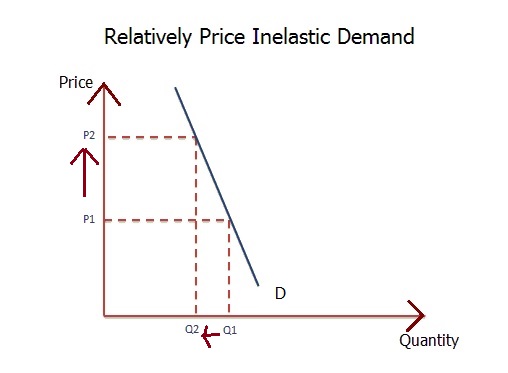 | In such a small city like Hong Kong, MTR provides the largest and the most efficient public transport in the market, which covers nearly every location of Hong Kong. Since MTR is a well-established firm for train services in Hong Kong, and there aren’t many substitutes, an increase in price of train tickets are would not significantly decrease the demand for it; therefore they are relatively price inelastic. For example, this year in June, there will be a raise in price by 5.4%, and it is predicted that there will be an even higher profit for MTR. In Hong Kong, the barriers to entry are very high, this is due to the fact that most of the underground land of Hong Kong are owned by MTR already, which led to the geographical limitation for any other businesses trying to enter this market in Hong Kong. |
Referring to the diagram above, if there is an increase in the price of MTR train tickets from P1 to P2, demand will decrease from Q1 to Q2. However, the decrease in demand is proportionately smaller to the increase in price. Thus, MTR will experience an increase in total revenue despite the decreased demand for its services
 |  |
Due to the fact that MTR is considered a monopoly, it does not have any competition in the market. Therefore, it has no incentive to provide its services effectively, or to produce at maximum productive efficiency. Productive efficiency is when a firm uses all of its factors of production efficiently and produces at minimum average cost. This is illustrated in the diagram on the right, The point of maximum productive efficiency is P1Q1, when the marginal cost curve intercepts the average total cost curve from the bottom. | 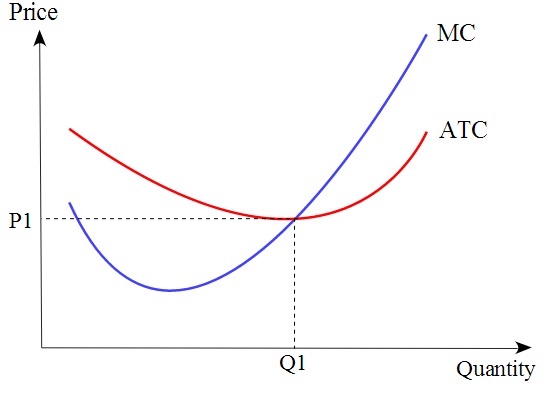 |
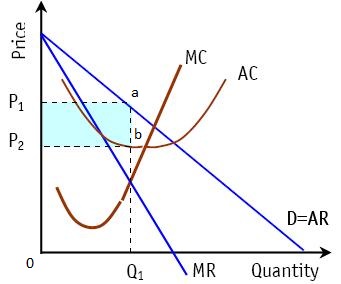
Driven by profit motive, MTR will aim to produce at the profit-maximising level of output. If MTR wishes to maximise its profits, it should produce at the level of output where the marginal cost (MC) curve cuts the marginal revenue (MR) curve from below. This is seen in the two diagrams below.
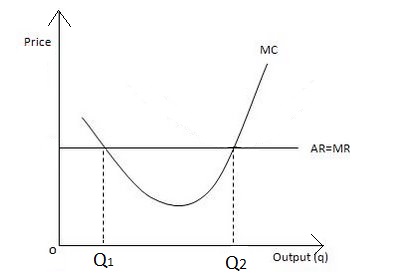 |  |
Referring to the diagram on the left, Q1 is the profit minimising level of output. That is, MTR would have been making a loss on every unit produced up to this level of output. When MTR is producing between Q1 and Q2, it will make abnormal profit. Q2 is the profit maximising level of output, and MTR should aim to produce at this level of output for profit maximisation.
If MTR is producing at the profit maximising level of output, then the profit per unit of output that MTR would make is the difference between the average revenue (AR) curve and average cost (AC) curve (a-b on the graph on the right). The abnormal profit MTR would make is shown as the blue region on the graph.
